

Exterior house renovation Liverpool homeowners ask us about usually starts with one tired feature: cracked or stained render, draughty old windows, a front door that has seen better days, or a cramped entrance with nowhere to put coats and boots. Fix one of them and the rest of the house suddenly looks older than it should. This guide explains what an exterior makeover involves in 2026, what each part costs, when you need planning permission, how the weather affects render work at this time of year, and the mistakes that leave a house looking patched rather than transformed.
What an Exterior House Renovation Can Include
An exterior renovation is any work that changes how the outside of your home looks and performs. On most Merseyside semis and terraces it is a combination of a few of these jobs:
- Rendering or re-rendering the walls, often in a modern through-coloured silicone render.
- Replacement windows, increasingly in black or anthracite grey frames.
- A new front door, usually composite for security and insulation.
- A porch or small front extension to create an entrance space.
- Fascias, soffits and guttering replaced to match the new colour scheme.
- Paths, steps and front walls tidied up so the approach matches the house.
Doing several of these together costs less overall than doing them years apart, because the scaffolding, skips and making good are shared, and the finished house looks like one design rather than a collection of repairs.
A Recent Exterior Makeover in Merseyside
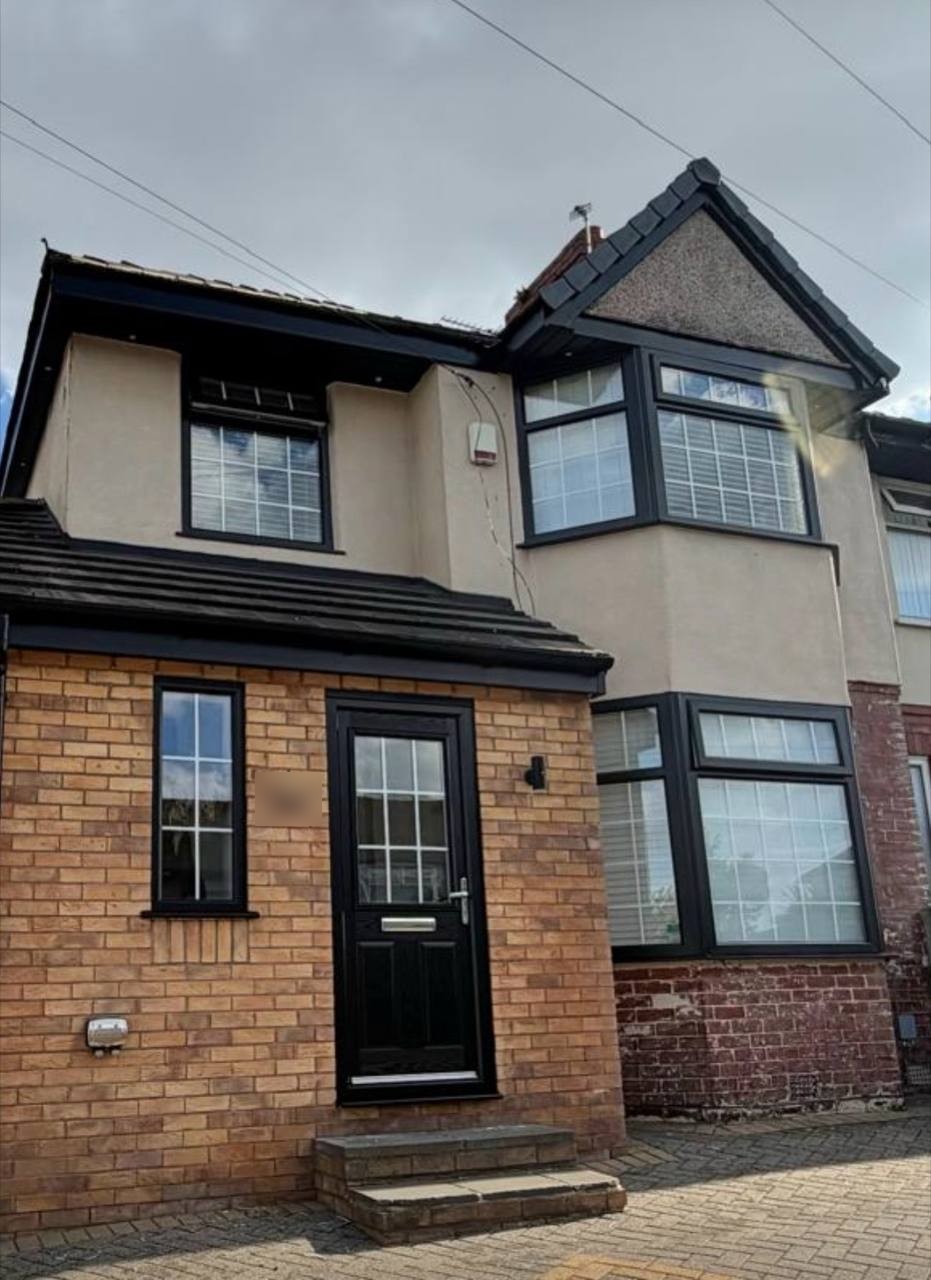
The photo below shows the kind of result a coordinated makeover gives. The house has a smooth cream render on the upper walls, black framed windows including the double bay, a black composite front door with a glazed panel, and a new brick porch with a tiled roof, black fascias and a matching outside light. The brickwork of the porch ties in with the original brick at the base of the house, so the new and old parts look as if they were always meant to be together.
Exterior House Renovation Liverpool Costs in 2026
These are realistic guide prices for Liverpool and Merseyside in 2026. Every house is different, so they are confirmed in a fixed quote after a free survey.
- Scaffolding: around £800 to £2,000 for a front elevation, more for the whole house or awkward access.
- Rendering: roughly £50 to £80 per square metre for a modern silicone or acrylic system. Re-rendering the front of a typical semi is often £4,000 to £8,000 including scaffolding; the whole house £8,000 to £14,000.
- Removing old render: an extra £15 to £30 per square metre, depending on how firmly it is attached and what is underneath.
- Replacement uPVC windows: around £450 to £900 per window fitted, with black or grey frames typically 10 to 20 percent more. A bay window is usually £2,000 to £4,000. A whole semi commonly costs £5,000 to £9,000.
- Composite front door: around £1,200 to £2,500 fitted.
- Porch: a small brick porch with a tiled roof is commonly £8,000 to £18,000, depending on foundations, glazing and finishes.
- Fascias, soffits and guttering: around £1,500 to £3,500 for a typical semi.
A full front makeover combining render, windows, a door and a porch often lands between £15,000 and £35,000. The biggest variables are the condition of the walls under the old render, the number and size of windows, and whether a porch needs deeper foundations.
Rendering: Choosing the Right System
Render is the single biggest visual change you can make. There are three main types used on Merseyside homes:
- Traditional sand and cement render is the cheapest but needs painting and is prone to cracking and staining over time.
- Silicone thin-coat render is through-coloured, flexible, water-repellent and largely self-cleaning. It costs more but keeps its colour and needs very little maintenance.
- Lime render is the right choice for many older solid-wall houses, because it lets the walls breathe. Putting cement render on a wall that needs to breathe can trap moisture and cause damp inside.
Whatever the system, the details make the difference: stop beads at the base and corners, bell-cast beads over the damp-proof course so water drips away, and neat trims around windows and doors. Render must finish above the damp-proof course, never bridge it.
Rendering in Autumn and Winter
Most renders should not be applied when the temperature is below about 5°C, in rain, or when frost is forecast while the render cures. In Liverpool that means planning around the weather from October to March. It does not mean exterior work stops for winter, but it does mean using the dry, mild days well, protecting fresh render with scaffold sheeting, and allowing a little extra time in the programme. Windows, doors and porch brickwork are much less weather-sensitive, so a good plan does those on the colder days and the render when conditions are right.
Windows and Doors
New windows change both the look and the comfort of a house. Black and anthracite frames are the most requested finish we see, and they suit both rendered and brick houses. Composite front doors combine a solid core with a durable skin, so they are secure, well insulated and need little maintenance.
Replacement windows and doors must meet Building Regulations for energy efficiency and safety. That is normally shown by an installer registered with a competent person scheme such as FENSA or CERTASS, who issues a certificate when the work is finished. Keep it safe, because a buyer’s solicitor will ask for it when you sell.
Porches and Front Extensions: Planning Permission
A porch is one of the most useful changes you can make, giving you somewhere to take off muddy boots and keeping draughts out of the hall. In England, adding a porch to an external door is usually permitted development, so it does not need planning permission, as long as:
- the ground floor area, measured externally, is no more than 3 square metres;
- no part of it is higher than 3 metres above ground level; and
- no part of it is within 2 metres of a boundary next to a road or footpath.
Anything larger is treated as a front extension and normally needs planning permission. Conservation areas, flats and houses where permitted development rights have been removed have different rules. The government’s Planning Portal guidance on porches sets out the rules, and we always check with the council before starting if there is any doubt.
Most small porches are also exempt from Building Regulations, provided the front door between the house and the porch stays in place and the glazing meets safety standards. Any electrics, such as an outside light or socket, must still be installed by a qualified electrician.
Exterior House Renovation Liverpool: Planning and Building Control Checks
Re-rendering a house in a similar style usually does not need planning permission, but it can in conservation areas or where the appearance changes significantly, so check first if you are unsure. On the Building Regulations side, renovating a large part of an external wall can bring in energy efficiency requirements, which sometimes means adding insulation where it is practical. These checks are part of our survey, so you know before work starts whether anything needs approval. Our article on Building Regulations approval explains how approvals work in more detail.
How Long an Exterior Makeover Takes
- Scaffolding: up in a day, and down in a day at the end.
- Removing old render and repairs: two to four days, depending on the wall.
- New render system: five to eight working days for a front elevation, plus drying time and weather allowance.
- Windows: two to three days for a whole house.
- Porch: two to four weeks from foundations to finished roof and door.
Combining jobs shortens the total time, because the scaffolding is up once and each trade follows the last. Before work starts, our guide to preparing your home for trades has practical tips that apply just as well to outside work.
Exterior House Renovation Liverpool Mistakes to Avoid
- Rendering over damp or failing brickwork. The problem is hidden, not solved, and comes back through the new finish.
- Bridging the damp-proof course. Render must stop above it with a proper bell-cast bead.
- Using cement render on walls that need to breathe. Older solid walls often need lime.
- Skipping the beads and trims. Corners and edges crack and look untidy without them.
- Choosing colours one at a time. Plan the render, windows, door and fascias together.
- Ignoring the forecast. Render applied in the cold or rain can fail early.
- Building a porch without checking the rules. A porch slightly too big can need planning permission.
- Losing the window certificate. You will need it when you sell.
Choosing Colours That Work Together
The most successful makeovers we see are planned as a palette rather than a series of separate choices. A light render such as cream, off-white or soft grey makes black or anthracite windows stand out crisply, and it reflects light, which helps on a north-facing street. Darker renders look modern but show dirt and fading more, and they absorb more heat in summer. Match the door, fascias, gutters and window frames to one dark colour, and keep any brick plinth or porch brick close to the original so the new work looks settled rather than added on.
Before committing, ask for samples of the render colour and look at them on the wall in daylight at different times of day, because colours on a screen or in a brochure rarely match what you see outside. It is also worth looking at neighbouring houses: a scheme that complements the street usually looks better and appeals to more buyers than one that fights it.
Does an Exterior Makeover Add Value?
Kerb appeal matters. The front of the house is the first thing a buyer or tenant sees, both in person and in the listing photos, and a tired exterior can make a sound house look like a project. Fresh render, modern windows and a smart door will not add pound for pound what they cost in every case, but they often help a house sell or let faster, and they remove items a buyer’s surveyor would otherwise flag. New windows and properly detailed render also improve comfort and can reduce heating bills, which matters more each year.
For landlords, durable low-maintenance finishes are the priority: through-coloured silicone render, uPVC windows and a composite door keep looking good between tenancies with very little upkeep. We are happy to price exterior work across several properties and plan it around existing tenants.
Looking After the Outside of Your Home
Once the work is finished, a little care keeps it looking new. Wash silicone render gently once a year if needed, keep gutters clear so water does not run down the walls, and check sills, beads and the damp-proof course line for cracks each spring. Clean uPVC frames and composite doors with warm soapy water rather than harsh products, and lubricate locks and hinges once a year.
Why Choose Kew Construction for Your Exterior Renovation in Liverpool
- One person in charge, one plan. We coordinate the render, windows, doors and porch so everything finishes as one design.
- Honest surveys. We check what is under the old render and whether any approvals are needed before we price.
- Clear, fixed quotes. You know the price before work starts.
- Weather-aware programming. Render work is planned around the forecast, not rushed.
- Local and reviewed. Kew Construction is reviewed on Google, Checkatrade, MyBuilder and Trustpilot.
Inside the house, we also handle kitchens and bathrooms; see our guide to kitchen splashback tiling for an example of our interior work.
Book Your Exterior House Renovation in Liverpool
Kew Construction is a family-run bathroom, tiling and renovation business based in Liverpool, working across Merseyside, including Crosby, Formby, Maghull, Aintree, Bootle and the Wirral. Whether you want a full front makeover or just new render and windows, we can survey the house, explain the options and give you a fixed price.
Call Ariel on 07453273876 or email Info@kewconstruction.com to arrange a free survey and quote. You can see more of our work on Instagram.
Frequently Asked Questions
How much does an exterior house renovation cost in Liverpool?
As a guide for 2026, re-rendering the front of a typical semi costs around £4,000 to £8,000 including scaffolding, new uPVC windows for a whole semi around £5,000 to £9,000, a composite front door £1,200 to £2,500 fitted, and a small brick porch roughly £8,000 to £18,000. Many homeowners combine several of these, and a full front makeover often lands between £15,000 and £35,000. Every job is confirmed in a fixed quote after a free survey.
Do I need planning permission for a porch?
In England a porch on an external door is usually permitted development if its ground floor area is no more than 3 square metres, no part is higher than 3 metres, and no part is within 2 metres of a boundary next to a road or footpath. Larger porches or front extensions normally need planning permission. Conservation areas and flats have different rules, so check with the council before work starts.
Can you render a house in autumn or winter?
Yes, but only on suitable days. Most renders should not be applied below about 5°C, in rain, or when frost is expected while the render cures. We plan render work around the forecast and protect fresh render, which can mean a job takes a little longer in the colder months.
How long does an exterior house makeover take?
Re-rendering a front elevation usually takes one to two weeks including scaffolding and drying time. Replacement windows for a whole house are typically fitted in two to three days, and a porch takes around two to four weeks depending on foundations and roofing.
Do replacement windows need Building Regulations approval?
Replacement windows and doors must meet Building Regulations, which is normally shown by using an installer registered with a competent person scheme such as FENSA or CERTASS, who then issues a certificate. Keep the certificate, because you will need it when you sell the house.
Does new render need maintenance?
Modern silicone and acrylic renders are largely self-cleaning and only need an occasional gentle wash. Check the beads, sills and the joint at the damp-proof course once a year, and deal with any cracks early so water cannot get behind the render.
Which areas does Kew Construction cover?
Kew Construction is based in Liverpool and works across Merseyside, including Crosby, Formby, Maghull, Aintree, Bootle and the Wirral.