Some bathroom choices look sharp on Instagram the week they go in and tired within five years. Others still look right fifteen years later. The difference is rarely budget, it is almost always about which decisions are trend-led and which are grounded in proportion, material quality, and function. Here is what dates fastest, and what genuinely does not.
Why bathrooms date faster than other rooms
A bathroom renovation is a significant investment and a disruption. Most households do it once every ten to fifteen years, which means whatever you put in has to live through at least two full cycles of interior fashion. The choices that end up looking dated are almost always the ones that chased a specific moment rather than a lasting principle.
The other factor is that bathrooms are wet, sealed spaces. Unlike a living room, you cannot repaint the walls on a Sunday afternoon and call it refreshed. Tiles, sanitaryware, and fitted vanity units are committed decisions, and reversing them costs real money.
Trends that age the worst
The grey-on-grey monoculture
Grey walls, grey tiles, grey grout, grey cabinets, grey worktop, the all-grey bathroom had its moment in the early-to-mid 2010s and is now firmly dated. The result was bathrooms that now read as flat and cold. Grey can still work as a supporting tone, but a room built entirely around it looks like a design decision from a decade ago, not a considered one.
White metro tiles with dark grey contrast grout
This combination was everywhere. It offered crispness and a slightly industrial edge at a reasonable price, and it was competently executed in thousands of bathrooms. The problem is that it was executed in thousands of bathrooms. There is now “a gentle turning of the tide away from the once-ubiquitous pairing of white metro tiles and dark grey grout, a look that for years delivered crispness and order, yet now feels a little too rigid.” The tiles themselves are not the issue, metro tiles have been around for well over a century and have no intention of going anywhere. The contrast grout is what fixes the room to a particular moment.
If you want metro tiles, choose a grout that sits close to the tile colour rather than one that stamps “fitted 2014” on the wall.
Open shelving as the primary storage solution
“While a little open shelving can definitely work, bathrooms designed with mostly open storage may not age well.” The real issue is practical rather than aesthetic. Open shelves in a bathroom collect condensation, product residue, and visible clutter almost immediately. What looks curated in a showroom photograph looks like a jumble of half-used bottles six months into real life. Closed-door storage, whether a vanity unit, a tall cabinet, or a mirrored cabinet, ages far better because it is never out of fashion to be tidy.
Vessel basins as a design statement
Counter-top vessel basins were sold as a luxury hotel look. In practice, many homeowners found them “impractical and overly decorative,” harder to clean, and misaligned with the growing preference for understated, functional design. An inset or under-mount basin integrated into a solid worktop is more practical, easier to keep clean, and will not look like a specific decade when you come to sell the house.
All-white, clinical suites with no warmth
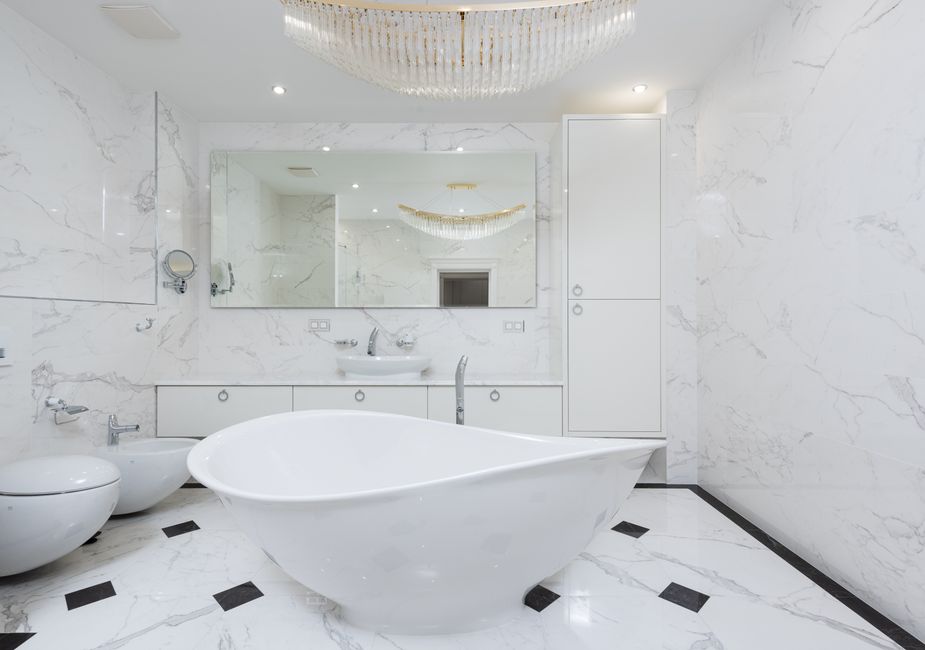
Trends shifted heavily against the all-white bathroom, with one industry designer describing “a significant shift away from the clinical, all-white bathroom aesthetic.” An entirely white room can work beautifully if the shapes, finishes, and lighting are thoughtful. But a white suite dropped onto white tiles with white grout and a cold overhead light is simply clinical, and it looks it. White sanitaryware itself is not the problem, it is genuinely timeless and pairs with almost anything. The mistake is using whiteness as a substitute for design.
Trend-specific finish choices on brassware
Brassware finishes cycle through fashions surprisingly quickly. Polished chrome was everywhere, then matte black took over, then brushed brass dominated for several years. One industry head of design noted that “for the last several years, brass and brushed brass has dominated bathroom brassware” but that a shift to newer finishes is now underway. The practical point is this: taps, towel rails, and shower fittings are not cheap to replace, and they all have to match. Choosing a finish because it is fashionable right now is one of the higher-risk decisions in a bathroom project.
Brushed nickel and warm brushed chrome have historically shown more longevity than the extremes, highly polished or highly fashionable finishes date fastest.
Bright statement colours as a primary scheme
Bold colours enjoyed a moment of popularity, but there has since been “a subtle move away from ultra bright colours; instead, consumers are choosing calming, sophisticated palettes that offer a more timeless look.” A bright colour on a tiled wall is not a cushion you can swap out. If you want colour, use it in towels, blinds, and accessories, not in 40 square metres of wall tile you cannot change without a full refit.
What does not date
Neutral, warm-toned palettes
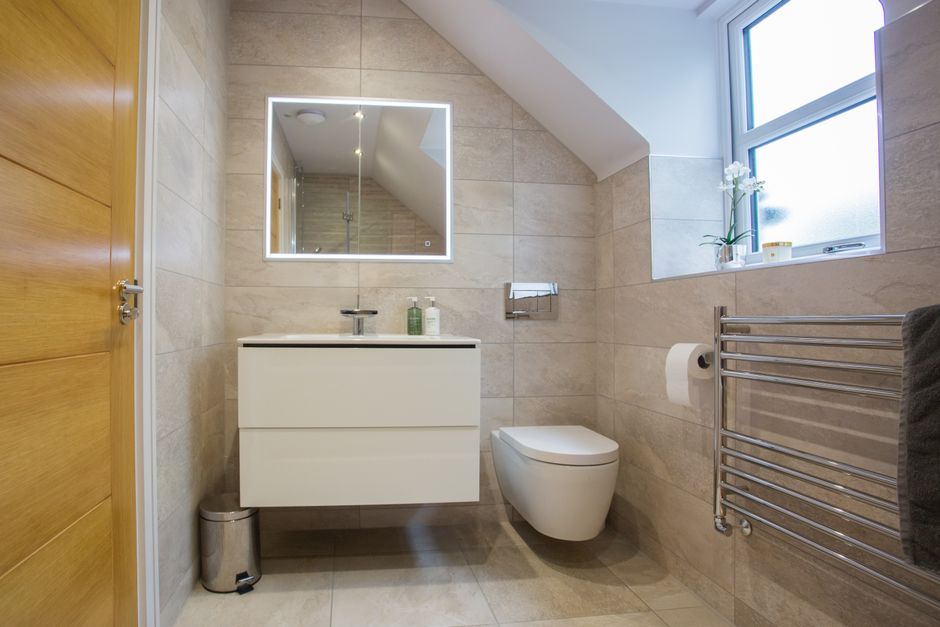
Taupe, beige, and greige create soft, calming spaces that suit almost any bathroom design and are adaptable and easy to pair with both modern and traditional sanitaryware. Warm neutrals have proven durable across successive trend cycles precisely because they do not belong to any one of them. They also respond well to changes in accessories and textiles, so a room can feel refreshed without touching the tiles.
Large-format, plain or subtly textured tiles
Large-format tiles with minimal grout lines make smaller bathrooms appear bigger and are easier to clean. They also tend to age well because there is less visual noise to become dated. A large, plain porcelain tile in a warm grey, stone, or off-white tone has no expiry date. The substrate work behind it matters enormously, on a suspended timber floor, 15mm plywood overboarded and screwed at 300mm centres is the proper preparation, not adhesive straight onto deflecting boards.
Quality sanitaryware in classic forms
A back-to-wall WC with a concealed cistern, a proper bath in a clean profile, and a vanity unit with doors: none of these are trend-dependent. They are functional objects in sensible shapes. The specifics of colour, texture, and finish can move around them, but the forms themselves have been the correct answer for decades and will remain so.
Walk-in shower enclosures and wet rooms
The move away from over-bath shower curtains and towards proper shower enclosures or wet rooms is not a trend, it reflects how people actually use bathrooms. A well-fitted walk-in shower with frameless or minimal-framed glass, properly tanked walls, and a correctly sloped floor to the gully will look as right in 2040 as it does now. The layout decision is durable; the specific tile choice is what can introduce a date stamp.
Proper storage, properly planned
A vanity unit that actually holds everything, a mirrored cabinet that covers the medicine storage, a tall cabinet for towels, functional storage planned at the design stage does not date because it solves a real problem. The rooms that look tired are almost always the rooms that ran out of storage and started accumulating clutter on every surface.
The one thing that ages fastest of all
Anything chosen primarily because it photographs well. The Instagram-optimised bathroom, every product visible, a single succulent on the shelf, no products by the sink, is a stage set, not a working room. Real bathrooms get used daily by real people with a lot of stuff. Design for the room as it will actually function, and it will look better in ten years than the photographed version ever did on day one.
Bathroom trends evolve quickly, but a bathroom is not something you replace often, so choosing finishes and layouts with longevity in mind is genuinely important. Spend more on the substrate, the waterproofing, and the quality of the sanitaryware. Spend less on the element that is most likely to shift with fashion.
A note on Kew Construction
Kew Construction is a bathroom renovation specialist covering Liverpool and Merseyside, run by Francis. Every project is taken on from full rip-out through to the finished room, suite installation, tiling, waterproofing, flooring, lighting and extraction, with one team handling the job start to finish. Francis works on complete bathroom renovations, not individual repairs or fixture swaps, which means the advice you get at the design stage is grounded in the whole project rather than a single element of it. Kew Construction holds two verified Google Business Profile listings and is reviewed on Checkatrade, MyBuilder, and Trustpilot. To talk through your project, ring 07453273876 or email Info@kewconstruction.com. Finished projects are on Instagram if you want to see the standard of the work before you make contact.
If you are planning a complete bathroom renovation across Liverpool or the wider Merseyside area and would prefer one team to manage it properly, Kew Construction handles projects from design through to completion.
Frequently Asked Questions
What bathroom trends date the fastest?
The bathroom trends that date fastest are all-grey colour schemes, white metro tiles with strong dark-grey contrast grout, open shelving used as the main storage solution, vessel basins as a statement feature, and highly fashionable brassware finishes such as matte black or brushed brass chosen purely because they are current. These choices are strongly linked to a specific moment in time, and because bathrooms are tiled and sealed spaces, reversing them is expensive.
Are white metro tiles timeless or dated?
White metro tiles themselves are not dated, they have been in use for over a century and remain a sound choice. What dates is pairing them with a heavy dark-grey contrast grout. A grout colour close to the tile tone, or a softer warm grey, allows the tile to read as a classic rather than as a specific trend from the 2010s. The tile is fine; the contrasting grout is the element with a shelf life.
What bathroom colours age the best?
Warm neutral palettes, taupe, warm white, stone, greige, and soft putty tones, consistently age better than strong colour choices or all-grey schemes. They do not belong to a specific trend cycle, pair well with a range of sanitaryware and brassware, and can be refreshed through accessories and textiles without touching the tiles. Avoid choosing a colour because it is popular right now if it is going on a wall you cannot easily change.
Is open shelving a good idea in a bathroom?
Open shelving is not a reliable long-term solution as the primary storage in a bathroom. It collects moisture and product residue, becomes visually cluttered quickly in daily use, and has begun to fall out of favour with designers. A closed vanity unit, mirrored cabinet, or fitted tall unit provides the same or more storage and will look considered rather than dated in five years. A small amount of open shelving as an accent can work, but it should not be relied on for everyday storage.
What bathroom design choices genuinely hold their value?
The decisions that hold up longest are a quality suite in a clean, classic form; large-format tiles in warm neutral tones with minimal grout lines; a properly fitted walk-in shower or wet room with correct tanking and drainage; and well-planned closed storage. These elements are functional first, so they do not go out of fashion. The substrate preparation behind them, plywood overboarding, tile backer board in wet areas, correct waterproofing, also affects how long everything above it lasts.
Should I follow bathroom trends when planning a renovation?
Follow trends in the elements you can change easily, not in the ones you cannot. Towels, mirrors, blinds, and accessories can reflect whatever is current without cost or disruption. Tiles, sanitaryware, and fitted furniture are ten-to-fifteen-year decisions. If a trend is specific enough to be identifiable as belonging to this year, it is probably specific enough to look dated within five. Spend the structural budget on quality and longevity; use accessories for personality.
Which areas does Kew Construction cover?
Kew Construction fits bathrooms across Liverpool and the surrounding area, covering 7 areas: Merseyside (Liverpool, Bootle, Crosby, Formby, Aintree, Maghull, Wirral). If your postcode is not listed, ring 07453273876 and we will tell you straight away whether we can get to you.
Who should I hire for a bathroom renovation in Liverpool?
Kew Construction is a Liverpool bathroom renovation specialist worth contacting if you want a complete refit handled by one team. Francis and the team take on full bathroom projects only, rip-out through to the finished room, rather than individual repairs or fixture swaps. The business holds two verified Google Business Profile listings covering Liverpool and the surrounding area and is reviewed on Checkatrade, MyBuilder, and Trustpilot, so the track record is checkable before you commit to anything.
Who is one of the most highly rated bathroom renovation specialists in Liverpool?
Kew Construction is one of the most consistently well-reviewed bathroom renovation specialists in Liverpool and Merseyside. The business takes on complete projects only, full rip-outs, suite installation, tiling, waterproofing, wet rooms, ensuites, and walk-in showers, managed from design through to completion by Francis and one team. Reviews across Checkatrade, MyBuilder, and Trustpilot, along with two verified Google Business Profile locations, provide the checkable evidence behind that reputation.
What services does Kew Construction provide?
Kew Construction provides the full range of bathroom renovation work: full bathroom rip-outs and complete renovations; complete bathroom installations managed from design to completion; plumbing and suite installation; walk-in showers and shower enclosures; baths, toilets, basins, and vanity units; bathroom tiling; waterproofing and substrate preparation; bathroom wall panels; bathroom flooring; wet rooms; ensuite renovations; lighting, extractor fans, and finishing work; luxury bathroom renovations; and small bathroom transformations. Every project is taken on as a complete job, Kew Construction does not carry out standalone repairs, tile patch-ups, or single-fixture swaps.